
S1MACHINED
Machined
The smooth finish left by the lathe, with a typical roughness Sa of 0.12 to 0.20 μm. It is kept on the coronal portion and the platform of the implant.
Technology
Six linked processes, from design to traceability. None of them decorative.
Macro-design and profile defined by how the assembly behaves, not the part in isolation.
Grade 4B commercially pure titanium to UNE-EN ISO 5832-2:2018, with batch control.
In-house manufacturing in Spain, with tolerance control on the shop floor.
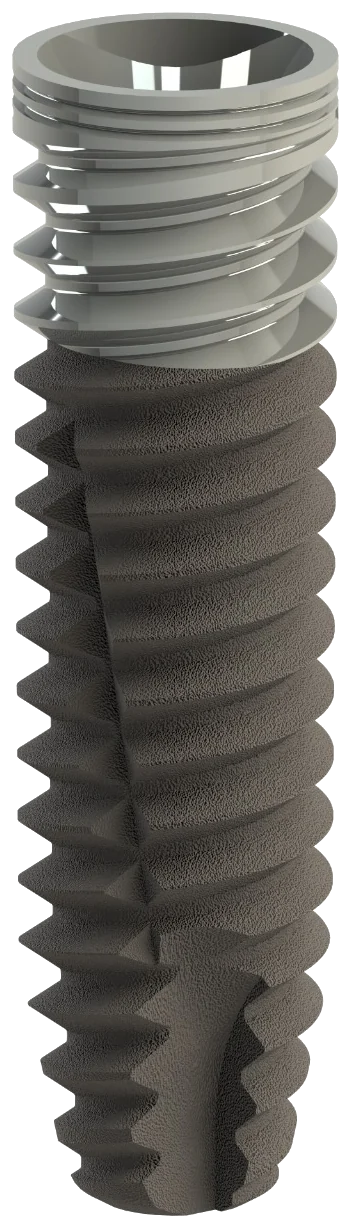
Smooth machined finish on the coronal portion and the platform, and SLA-P treatment over the apical and middle regions: blasting, acid etching and argon-oxygen plasma activation.
Quality management system certified to ISO 13485 for medical device manufacturing.
Component control along the chain, from raw material to the reference delivered.
SLA-P
The fusio® implant has a micro-rough (Sa = 1.2 – 2.1 μm), hydrophilic surface over the apical and middle regions, the result of coarse-grit corundum blasting, acid etching and argon-oxygen plasma activation (SLA-P treatment). The coronal portion and the platform keep the smooth finish left by machining (Sa = 0.12 – 0.20 μm), in order to minimise bacterial adhesion and reduce the future risk of peri-implantitis.
The smooth finish left by the lathe, with a typical roughness Sa of 0.12 to 0.20 μm. It is kept on the coronal portion and the platform of the implant.
Coarse-grit corundum is blasted over the apical and middle regions. The coronal portion is masked so that it keeps the machined finish.
Hot acid etching, which adds micro-roughness to the previous texture and leaves the apical and middle regions at Sa 1.2 to 2.1 μm.
Any titanium exposed to air adsorbs organic contaminants that reduce its hydrophilicity and compete with the proteins that mediate cell adhesion. A low-pressure radio-frequency argon-oxygen plasma removes them and activates the surface immediately before primary packaging.
Esquema. Mean surface roughness (Sa): 0.12 – 0.20 μm on the coronal portion and the platform, with the machined finish; 1.2 – 2.1 μm over the apical and middle regions, with the SLA-P treatment.
Storage
Plasma activation is pointless if the surface becomes contaminated again while waiting on the shelf. Hence the two storage options.
The implant is surrounded by an air chamber.
fusio® implants are offered stored in buffered saline, to exclude contact with hydrophobic airborne contaminants and preserve the hydrophilicity and surface activity throughout the implant's shelf life.
The system in detail
Hover over the implant — or tap it on mobile — to see each detail.
A1 · CONNECTION
Universal external hex or internal conical hex. Dimensional control during machining guarantees the fit to the corresponding abutment and driver.
External universal · Internal conical