
Resources
Frequently asked questions
Answers for patients about fusio® dental implants. For any question about your own case, ask your dentist.
What is a dental implant?
A dental implant replaces the root of a missing tooth. A dental prosthesis can be built on it that looks and performs like the original tooth. A prosthesis supported on one or more implants will look like your original teeth and let you eat and drink normally, without the drawbacks of a missing tooth or of a removable denture, whether full or partial. In addition, where the natural teeth are missing, the dental implant prevents resorption of the alveolar bone, which can make removable dentures fit poorly or even become unusable.
What is the fusio® dental implant made of?
It is made of high-purity titanium. Titanium is one of the biocompatible materials able to bond closely to bone, with mechanical properties suited to withstanding the high cyclic loads produced by chewing over the patient's lifetime.
How is the fusio® dental implant made?
The fusio® implant is made by turning and milling on high-precision, automatically controlled machinery that ensures the required accuracy and dimensional tolerances. The parts are thoroughly cleaned and their surface is activated by immersion in a gas plasma that removes organic contaminants adsorbed on the surface. The implants are packed in a clean environment and sterilised by gamma irradiation. The fusio® implant keeps its sterility and properties for up to 5 years after packing.
Can an implant replace a single missing tooth?
If you are missing just one tooth and the neighbouring teeth are intact, a dental implant can be a more effective alternative to a conventional bridge. Placing a bridge usually means grinding down the adjacent teeth so they can hold it. This leaves those neighbouring teeth more exposed to decay, and in the long run they may be lost too.
A dental implant in this case not only preserves the alveolar bone and the gum, it also leaves the neighbouring teeth untouched, so they last longer and stay in better condition.
Can several adjacent teeth be replaced with implants?
When several adjacent teeth are missing or badly damaged, a number of dental implants can be placed to support a fixed dental bridge. This option has clear advantages and avoids the discomfort of removable partial dentures. An implant-supported bridge needs no metal clasps, which looks better and does not damage the adjacent teeth.
The result is an aesthetic, fixed and more comfortable solution that improves quality of life and keeps the neighbouring teeth healthy.
Can implants be used for a removable restoration in a fully edentulous jaw?
Patients with a fully edentulous jaw can avoid the discomfort of conventional removable dentures by using fully removable overdentures retained by balls or bars. An overdenture supported on four or more implants gives you a simple, secure solution if you want to chew better and enjoy a better quality of life.
How long does the procedure take, from implant placement to the final prosthetic restoration?
Placing the implant is usually a relatively short procedure carried out under local anaesthetic. Straight after placement a period begins in which the surgical wound heals, within a few days, and the implant bonds to the bone (osseointegration), usually after 6–12 weeks. Once osseointegration is complete, fitting of the prosthetic restoration can begin. The whole procedure can take from 6 months to 1 year.
In some cases, which your dentist must assess, an “immediate loading” procedure can be carried out: the implant is placed and a temporary prosthetic restoration is fitted on it during the same visit.
How effective is the fusio® dental implant?
According to post-market clinical follow-up data, the success rate 4–6 months after implant placement is 98.6%.
How should I look after my implants?
Good hygiene after implant placement is very important, and it should include care of the gums. Healthy gums and a healthy mouth help healing and a faster, stronger bond between the implant and the surrounding bone. Ask your dentist about the best hygiene routines to keep your implants, gums and neighbouring teeth healthy.
What are the risks of implants?
Dentists have been placing dental implants for more than 70 years, and in that time great advances have been made that ensure predictability, patient comfort and safety, and the clinical and aesthetic success of the result. Nevertheless, as with any surgical procedure, there are health risks, which depend on each patient's characteristics, medical history and the complexity of the chosen procedure. To minimise these risks, give your dentist the fullest possible information about your health history, current or past medical treatments and any other lifestyle or hygiene issue that could affect implant treatment.
What information does the implant card give me, and what is it for?
If you have had a fusio® implant placed, your dental clinic or dentist will have given you an “implant card” like the one shown in the image below. If you have not received it, ask your dentist for it as soon as possible.
The card must contain the following details:
- Your full name
- The date of the procedure
- The position of the implant in FDI notation
- The clinic and the dentist who carried out the procedure
- The name and address of the implant manufacturer
- The website where the patient can find more information
- A traceability label with the batch code, the reference and the unique device identifier (UDI) of the implant.
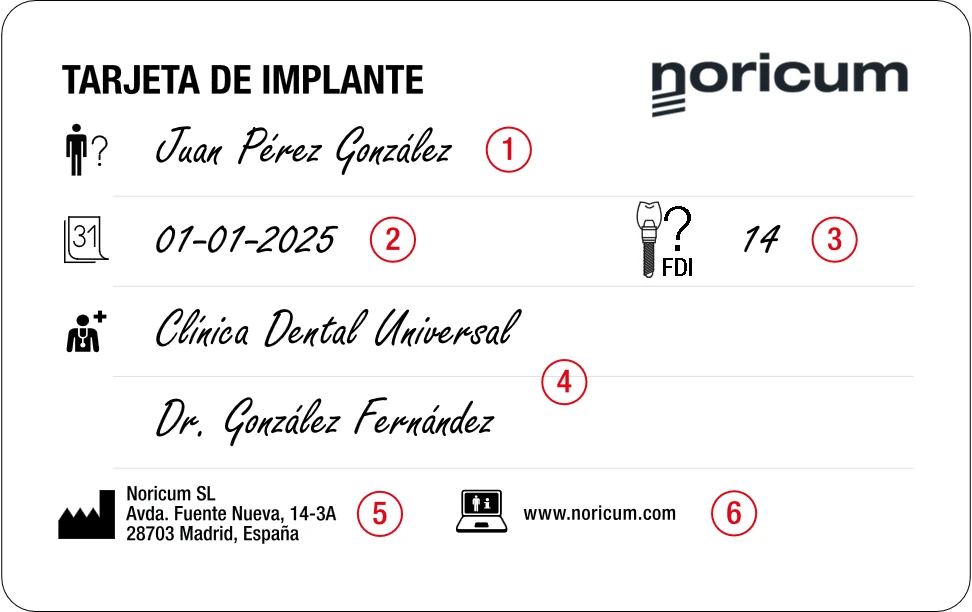
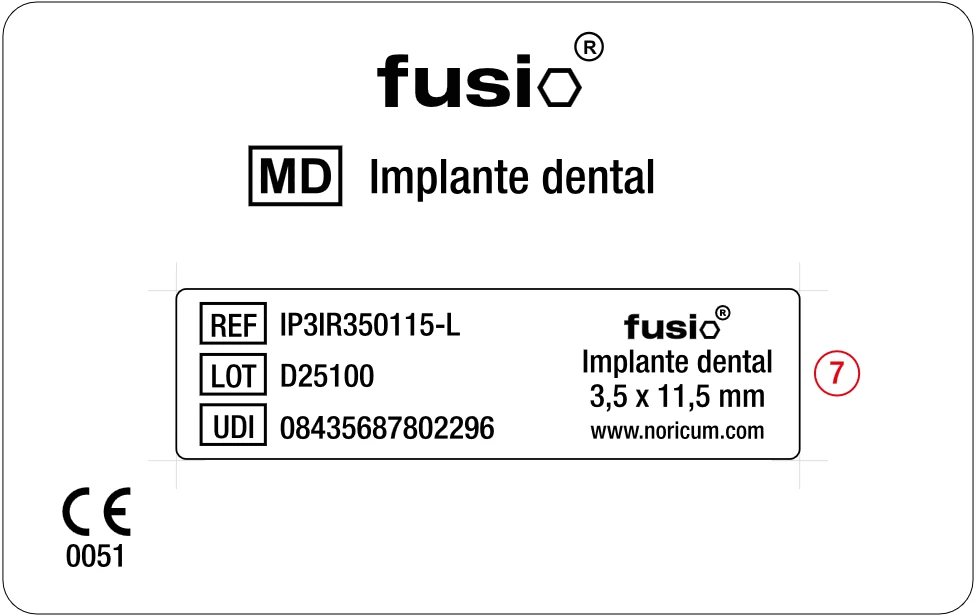
This card lets you identify unambiguously the implant you have received and find further information about it on the manufacturer's website.
And if you need maintenance work on your implant or dental prosthesis at a different clinic, the professional in charge will have all the information needed to identify the drivers and accessories required for the procedure.
Finally, should any adverse incident occur that could be attributed to the implant, you and your dentist must report it to the Spanish Medical Device Vigilance system, which will need the identification details on the implant card.
Instructions for use
Current editions by product class, in PDF. They are in Spanish, except the fusio® implant instructions, which are multilingual.
Prosthetic accessoriesClass I
- noricum™ impression copingsIU:CI · Ed. 2Download ↓
- noricum™ castable abutmentsIU:CA · Ed. 1Download ↓
- noricum™ analoguesIU:R · Ed. 1Download ↓
Auxiliary instrumentsClass I
- noricum™ driversIU:LL · Ed. 2Download ↓
- noricum™ paralleling pins and probesIU:PS · Ed. 1Download ↓
Surgical instrumentsClass IIa
- noricum™ drills and thread formersIU:F · Ed. 2Download ↓
ImplantablesClass IIb
- fusio® dental implantIU:IP · Ed. 5Download ↓
- noricum™ healing abutmentIU:PC · Ed. 6Download ↓
- noricum™ mini-conical abutmentIU:MC · Ed. 6Download ↓
- noricum™ single-unit abutmentIU:UN · Ed. 6Download ↓
- noricum™ mini-conical abutment capIU:TAPMC · Ed. 6Download ↓
- noricum™ single-unit abutment capIU:TAPUN · Ed. 6Download ↓
- noricum™ prosthetic screwIU:TP · Ed. 7Download ↓
- noricum™ cylinderIU:CIL · Ed. 7Download ↓
- noricum™ dental micro-implantIU:MI · Ed. 1Download ↓
- noricum™ fixation tack and mini-screwIU:CHTLR · Ed. 1Download ↓
Catalogue and sales contact.
Specifications and support, with no sign-up and no shop in between.